

Monday, February 14, 2011

Friday, February 11, 2011
A Million Miles in a Thousand Years By Donald Miller

Donald Miller wrote a book that was successful, and some guys wanted to make it into a movie. As they start writing, they need to create a more interesting protagonist. And so Don begins to evaluate his life as a story. "The truth is, if what we choose to do with our lives won't make a story meaningful, it won't make a life meaningful either." When I did some research about this book, the two things mentioned are his progress in making a movie about the first book, and his bike ride across the US to raise money for clean water in Africa. And I think those are the book ends to this story, but what was most valuable to me, was his self-evaluations and efforts to positively change what he was doing in his life. I know I've mentioned this before, but I always wonder if we really, really can permanently change our lives. I know in theory it's true, but to actually overcome bad habits, stay motivated, and be successful seems almost impossible sometimes.
As Don begins to find positive ways to spend his time and invest his energy, he comes in contact with and makes friends with tons of interesting people. Bob, one of them, is absolutely amazing, you will enjoy reading his story. Another friend, an artist, says, "He wondered out loud if the point wasn't the search but the transformation the search creates." Don writes about how we often need a catalyst to change, something that forces us out of our routine. "Humans are designed to seek comfort and order, so if they have comfort and order, they tend to plant themselves, even if their comfort isn't all that comfortable. And even if they secretly want for something better." And also, "People love to have lived a great story, but few people like the work it takes to make it happen." Oh, I am so often one of those people! And reading this really did make me want to make my life a better story! I can totally relate to that plateau you reach and sometimes stop at in your efforts to improve. "They get into the middle and discover it was harder than they thought. They can't see the distant shore anymore, and they wonder if their paddling is moving them forward...."
It doesn't take long in the book for Don to begin talking about God. At first he mentions imagining talking to God after he dies, and being held accountable for what he did with his life. (This fits in great with my beliefs.) And he realizes that "God will probably sit there looking at me, wondering what to talk about next." While it becomes obvious that Don is religious, I believe that he wanted those who might not share his beliefs to also benefit from this book. So the meaning is there, but I wouldn't call this entirely a religious book.
"If I have a hope, it's that God sat over the dark nothing and wrote you and me, specifically, into the story, and put us in with the sunset and the rainstorm as though to say, Enjoy your place in my story. The beauty of it means you matter, and you can create within it even as I have created you." Yes, I think so.
There is a chapter that I REALLY liked called, "The Reason God Hasn't Fixed You Yet." And I've been trying to quote from it or paraphrase, and I'm afraid if I do it will be misunderstood. Just believe me, it's good. Oh, and the story, "How Jason Saved His Family" made me cry, seriously.
Don Miller has a sense of humor, and the parts in this book that made me laugh aren't forced. Like he talks about reading an article about advertising and how it causes us to think in "wish-fulfillment dynamics." On the other side of the page was an ad for a specialized remote control. Then he says, "I had trouble finishing the article about the effects of advertising because I kept pressing my finger against the picture of the remote, imagining my television turning on and off." Also he doesn't over explain, he just assumes his readers are intelligent and can draw the conclusions he's making throughout his book.
Here's another great point, "When you stop expecting people to be perfect, you can like them for who they are."
And another, "A good storyteller doesn't just tell a better story, though. He invites other people into the story with him, giving them a better story too."
He talks about the need for opposition and sacrifice. He comes to the conclusion that, "It wasn't necessary to win for the story to be great, it was only necessary to sacrifice everything." This made me think about Young Women lessons that I've given about sacrifice. Which have in turn made me ask myself, "what do I sacrifice?" And the truth is that often it's not very much. I am usually willing to do great acts of charity or service when it fits neatly into my life. I know that it is more meaningful when it requires me to miss out on something, or inconvenience myself to help someone else.
"It made me think about the hard lives so many people have had, the sacrifices they've endured, and how those people will see heaven differently from those who have had easier lives."
I could seriously quote this book all day long. I'll end with this one:
"I knew a story was calling me...and once you know what it takes to live a better story, you don't have a choice. Not living a better story would be like deciding to die, deciding to walk around numb until you die."
I recommend it. I thought it was great start to finish. I took lots of notes (obviously).
PS. THIS IS MY 100TH REVIEW! Look for a commemoration next week!
Tuesday, February 8, 2011
All About Lulu by Jonathan Evison

Will is a tragic character. His mom dies when he was 10, and his brothers and Dad are meat-loving body builders. He doesn't fit in, and literally stops growing when he loses his mom. "I was living inside of myself; that is, my world was inside out. I had senses, but they were all on the inside. The sense that something was missing. The sense that this missing thing would elude me forever..." It is so sad. Then his dad remarries an old sweetheart, who is also a grief councilor. Along with her comes a step-sister that Will falls in love with. "...allowing this miracle of a girl to tickle the edge of my despair simply by listening to the sound of my voice, and something opened in my chest and tingled like a frostbitten had regaining its warmth." They become best friends, he keeps notebooks filled of his memories of her, and a few other weird obsessive things happen. You are happy for Will because he is happy. Of course that is all mysteriously shattered when Lulu goes away for the summer and something happens. Next there are these painful years where she ignores him. Then as young adults they have a few intense emotional scenes together. It goes up and down and up and down. Not until the VERY end is the big secret revealed to Will and the reader (although I was pretty sure what the deal was about half way through.) For me it went on too long. I couldn't help but think that in real life it would have been talked about sooner. BUT the ending is done well.
There are somethings I liked alot about this book:
1) I think Evison has a nice way with words. They are clever without being too over the top. I liked the style of his writing.
2) I liked the way the family sticks together and in the end there are two great scenes of reconciliation. First with his younger brothers, and second, with his father. Both are really beautiful. Really. There is this time when Will looks back at awkward family dinners and realizes how much he misses them, and how they held the family together.
3) There is some good dialouge about whether people can or do change. Some of this is trite, but it's a theme I think about a lot. I think there are some good ideas expressed by the characters, and more good ideas shown through their actions.
4) Like any true coming-of-age novel, Will grows up. Most of the supporting characters go through some type of life-altering change.
But sadly, for me, the cons out weighed the pros.
Thursday, February 3, 2011
Mudhouse Sabbath by Lauren F. Winner
 It's safe to say I have never read any book like this before. I can't even think of a comparison. But I loved reading it, and I would recommend it to almost everyone I know.
Lauren Winner converted to Christianity from Orthodox Judaism when she was in college. That alone is mind-blowing to me. In this book she writes about 11 spiritual practices she misses from her "jewish ways." Then as she gives clear explanations of each practice, she explains how she is trying to incorporate it into her Christian life. The information is great, the writing is great, and reading it made me want to be a better person. It inspired me to evaluate my devotion, my spiritual practices, and what I could learn from traditions and practices of a religion I know very little about.
In her introduction she says, "Practice is to Judaism what belief is to Christianity." Then she writes, "your faith might come and go, but your practice ought not to waver." This totally resonates for me. There are times when I might be questioning my beliefs, or not feeling as convinced about something, but I just keep doing the things I know I'm supposed to be doing, and it comes around again. You know? And I think it's when you stop doing the things, that you stop believing. Not the other way around.
I loved when she talked about the Sabbath. "In observing the Sabbath, one is both giving a gift to God and imitating Him." Her descriptions of ushering in the Sabbath, and then enjoying it, were beautiful. I'll admit I've let some things slip in my observance, and reading this made me want to work more on Saturday, so that my Sabbath can truly be Holy.
The chapter on mourning was fascinating to me. Judaism has these very specific, structured time lines for mourning. I loved the part about the prayer that must be said twice a day, but must be said with 10 other people. So no one is left alone in their sorrow. When Winner has a close friend die, she is reminded that "I might not know what to do in the face of this death, but the tradition that raised me knew what to do." This made me think of the way that having practices and procedures can help you to deal with the pain.
Winner has a chapter on fasting. I love that she admits up front that she doesn't like to fast. So I think this chapter was especially personal in her attempts to find meaning and balance. "It is not meant to distract us from the really real, but rather to silence us so that we can hear things as they most truly are." This is a nice way of saying what I know, that fasting humbles us and makes it easier for us to be sensitive to the promptings of the Spirit. She also quotes a Rabbi saying, "When I am sated, it is easy to feel independent. When I am hungry, it is possible to remember where my dependence lies." One thing she doesn't mention, which is the only way I can fast, is fasting with a purpose. Having a particular need that I focus on all day gives meaning to my fasts.
Another great quote: "Most good and holy work is sometimes tedious, but these tasks are burning away our old selves and ushering in the persons God has created us to be." I love it.
There's another chapter about community, and I love that our church puts so much emphasis on creating a community, or family among believers. I know it isn't always successful, but it can be.
Tuesday, February 1, 2011
TH1RTEEN R3ASONS WHY by Jay Asher

The first time I ever heard of suicide I was 9, and a girl at the junior high up the hill killed herself. Everyone was talking about it for awhile, and I remember hearing it was because of a mean note some girls gave her. My mom helped me understand a bit more by explaining that there was probably a lot more to it than that. The note might have just been the final thing that made her do it. Everytime I hear tragic stories like these, I want to know why. Maybe so I can make sure they don't happen, or couldn't happen to people I know, but also just because. I think we all do. So I liked the premise of the book. All these students are stunned by the suicide, then they get their chance to really know why. BUT since they are all "on the tapes," they are somehow connected. Either a reason why, or someone who didn't stop her.
The writing switches back and forth between the narrator's, Clay's, thoughts, and Hannah's recorded voice on the tapes. There are parts where this is done really well, switching rapidly.
Here are some well-written phrases I marked:
"Hitting PLAY that first time was easy...I had no idea what I was about to hear. But this time, it's one of the most frightening things I've ever done. I turn the volume down and press PLAY."
"This tape isn't about why you did what you did, Alex. It's about the repercussions of what you did. More specifically, it's about the repercussions to me. It's about those things you didn't plan--things you couldn't plan." This is a recurring theme. One person does something, and it affects others' opinions of Hannah, and then they act accordingly. So maybe what someone does isn't as bad as the series of events that occur because of what they did.
"Right then, in that office, with the realization that no one knew the truth about my life, my thoughts about the world were shaken."
I was annoyed by the endingn when she drags a teacher into it. It felt tacked on, and not as developed as the rest. Almost like a poorly done afterthought. Also, she alludes to her parents being overwhelmed by other issues, and also to her life before moving here, but both are just casually mentioned. I kept waiting for either topic to be explored further, and I think it's kind of weird that they weren't.
So who would I recommend this too? It's hard to say. If you are intrigued by my review, read it. I think that the right highschool student would like it, but it addresses some tough topics so I might not put it in their hands. Only a couple of swear words, and the more graphic scenes are in sinuated instead of spelled out word for word. Chris Crutcher is quoted on the cover. It's been years since I read anything by him, but I think this book would fall in the same category as his books.
Friday, January 28, 2011
The Sweetness at the Bottom of the Pie
 Have I mentioned enough times that I love precocious, young female protagonists? I don't care if their expertise and eloquence are over the top, I like them a lot. Flavia de Luce fits right in with my favorites! She is 11, growing up in England in a sprawling mansion, and loves chemistry. She has discovered a well-stocked laboratory from an ancient uncle, and has made it her "sanctum sanctorum." Throughout the book she interprets and relates to happenings in terms of chemistry.
 Flavia has two older sisters, one a book worm and the other lovesick. The interaction between them is entertaining. Her mother tragically died, and her father, an avid stamp collector, is reclusive and disconnected from his daughters. The mystery begins when a dead bird is found on the back doorstep with a postage stamp stuck on its beak. (See cover illustration.) Next Flavia discovers a body in the cucumber patch. Being a child she is questioned, but not let in on much. So she begins an investigation of her own. She takes off on her bike, named Gladys of course, and solves the mystery.
The story is sometimes out there, and maybe not entirely realistic. But it is a great mystery, has fun dialouge, endearing characters, and it is nicely resolved. I liked reading it. Griffin, who is 11, tore through it too, and was excited to discuss it with me along the way. It is murder mystery, and I recommend it!
Here are some of Flavia's great lines:
About reading her first chemistry book, "Within moments it had taught me that the word iodine comes from the word meaning "violet," and that the name bromine was derived from a Greek word meaning "a stench." These were the sorts of things I needed to know!"
When she found the town library was closed, "It occured to me that Heaven must be a place where the library is open twenty-four hours a day, seven days a week. No...eight days a week."
"Wrapped up in the music, I threw myself into an overstuffed chair and let my legs dangle over the arm, the position in which Nature intended music to be listened to, and for the first time in days I felt the muscles in my neck relaxing."
This is gross, but she's describing the linoleum floor in a retirement house. "Whenever I stepped on one of its pustulent brown blisters, the stuff let off a nasty hiss and I made a mental note to find out if color can cause nausea."
I can totally relate to her explanation of how to solve a problem or remember something. "I could feel an answer to the question nibbling at the hook I'd lowered into my subconscious. Don't look straight at it, I thought, think of something else--or at least pretend to."
Oh, I almost forgot. The title comes from this quote:
Unless some sweetness at the bottom lie, who cares for all the crinkling of the pie?
Wiliam King, The Art of Cookery (1708)
Clever, I thought.
Monday, January 24, 2011
The Wednesday Wars by Gary D. Schmidt
My mom read this book for a children's lit class, loved it and gave me a copy. I started it, but didn't get sucked in, then read something else and left it on my nightstand. I'm telling you this, because I think The Wednesday Wars is a good book. For some reason I had to get into it a way to realize it. The narrator's voice wasn't really interesting to me at first, and I think I had to understand the characters before I cared about them. I wasn't sure what or who to focus on because there seemed to be a lot of little storylines going on. Each chapter is a month in the school year starting with September. Once I fininshed October I was hooked.
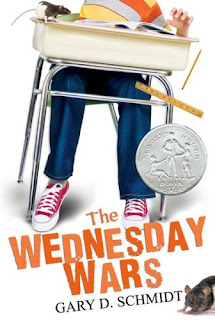 Holling Hoodhood (I know, I think the name was a dumb choice too), is a 7th grader in the late 60's. Teachers and staff members have husbands serving in Vietnam, he and his friends idolize Mickey Mantle, and his sister wants to be a hippie. I liked the social references, and I think the story provides a realistic look at life during this time, (although I wasn't there). I liked Holling. The story kind of revolves around his relationship with his teacher Mrs. Baker. He believes she hates his guts because he is the only student that doesn't go to Jewish or Catholic classes on Wednesday afternoon, so she makes him do menial jobs, or read Shakespeare. As the book goes on they become allies, and she seems to be the kindest person in his life.
I liked how things weren't perfect, but turned out OK. Holling is picked on, embarrassed, and dissappointed, but he does alright. There are a few really sad parts, and a few really funny parts.
A few of Holling's thoughts:
"How do parents get to where they can say things like this? There must be some gene that switches on at the birth of the first-born child, and suddenly stuff like that starts to come out of their mouths."
"Let me tell you, it's a pretty hard thing to be a seventh grader with new death threats hanging over you just about every day."
"Mrs. Bigio opened her mouth, but the only sounds that came out were the sounds of sadness. I can't tell you what they sounded like. But you know them when you hear them."
"Spring Break. Warm and green days. You know they aren't going to last, but when you start in on them, they're like a week of summer plunked down as a gift in the middle of junior high school."
This is age appropriate for middle grades, but I think maybe it would be best read aloud in class or at home for 10-12 year olds. I think students of this age would like the story, but would need encouragement to dig into it. Probably because it took me a second try.
I really liked how Holling would drop little Shakespeare phrases into his narration from whatever play he was reading. At first it was just the "cusses" like "toads, beetles and bats" or "pied ninny." But then he moves on and compares his life naturally with characters, and borrows phrases like "blithe and bonny." It works.
I think this is a really well-written book, and worth picking up. It is appropriate for kids, I'd say 10 and up.

I liked how things weren't perfect, but turned out OK. Holling is picked on, embarrassed, and dissappointed, but he does alright. There are a few really sad parts, and a few really funny parts.
A few of Holling's thoughts:
"How do parents get to where they can say things like this? There must be some gene that switches on at the birth of the first-born child, and suddenly stuff like that starts to come out of their mouths."
"Let me tell you, it's a pretty hard thing to be a seventh grader with new death threats hanging over you just about every day."
"Mrs. Bigio opened her mouth, but the only sounds that came out were the sounds of sadness. I can't tell you what they sounded like. But you know them when you hear them."
"Spring Break. Warm and green days. You know they aren't going to last, but when you start in on them, they're like a week of summer plunked down as a gift in the middle of junior high school."
This is age appropriate for middle grades, but I think maybe it would be best read aloud in class or at home for 10-12 year olds. I think students of this age would like the story, but would need encouragement to dig into it. Probably because it took me a second try.
I really liked how Holling would drop little Shakespeare phrases into his narration from whatever play he was reading. At first it was just the "cusses" like "toads, beetles and bats" or "pied ninny." But then he moves on and compares his life naturally with characters, and borrows phrases like "blithe and bonny." It works.
I think this is a really well-written book, and worth picking up. It is appropriate for kids, I'd say 10 and up.
Wednesday, January 19, 2011
Hotel at the Corner of Bitter and Sweet by Jamie Ford
 I really enjoyed reading this book. I've been struggling to come up with this post, and I'm not sure why. I'm guessing a lot of you have read this, it seems to be going around.
First of all, this title is perfect. It is the story of a 12-year-old Chinese American boy growing up in the International District of Seattle during World War II. His father is a Chinese Nationalist, and has fierce allegiances, which in turn translate to fierce hatred of Japanese people. Henry is on a scholarship at a white prep school, where he is taunted and tormented. When a Japanese American girl (second-generation) starts working in the cafeteria on scholarship also, the two become close friends. Their story leads us into Japanese Interment, and really captures the bitter sweetness of their friendship.
That's half the story. The other half is Henry as a recent widower, in 1986. He has a son of his own who is attending college. The Panama Hotel where Keiko's family stored some of their belongs has been recently purchased, and a basement full of Japanese families' belongs have been discovered. In these chapters Henry struggles to reconcile his old feelings of love and heartache.
I didn't mind the switching chapters at all. There were some elements that reminded me of Amy Tan's books, just the difficulty of raising children in a different culture than you live in. Henry's father goes from forbidding him to speak English, to suddenly forbidding him to speak Chinese. In the course of the book, their conversations go from strained to non-existent. In the 1986 chapters, you see how some of those communication problems have repeated themselves with Henry and Marty.
What I loved about this book is that love triumphs. Really sad things happen, a lot. But the characters keep trying. Also it has a good ending. I liked Jamie Ford's writing style, and I'm curious to see where he goes from here. I enjoyed the historical significance of what he captured. But for some reason, I had a little disconnect. I liked Henry and Keiko, and Sheldon and Marty, but I didn't fall in love with them. I read this pretty quick, but I wasn't anxiously sneaking in pages throughout my day.
Here are some good examples of Ford's talent for writing, that also show the tone of the book:
"As he left the hotel, Henry looked west to where the sun was setting, burnt sienna flooding the horizon. It reminded him that time was short, but that beautiful endings could still be found at the end of cold, dreary days."
"He envisioned staying at his uncle's house....and being teased by the locals for not being Chinese enough. The opposite of here, where he wasn't American enough. He didn't know which was worse."
"Inside had been a piece of hard candy and a quarter...The candy was so that everyone leaving would taste sweetness--not bitter. The quarter was for buying more candy on the way home--a traditional token of lasting life and enduring happiness." Henry is explaining the envelopes that were passed out at his wife's memorial service.
So I recommend it. I think it's a great book, and one of the best I've read lately. But it didn't have the impact on me that my favorite books have.
Friday, January 14, 2011
Garlic and Sapphires by Ruth Reichl
So this memoir begins as Ruth Reichl accepts a job as a food critic for the New York Times. It is a good combination of her experiences, her reviews, and recipes. I think it is well put together and was an interesting read. I've marked several recipes to copy and try. I think I'm trying her Spaghetti Carbonara next week.

Ruth developed characters complete with costumes, personalities and back stories in order to eat at restaurants without receiving special treatment. In fact, she often went in disguise, then again as herself. It was entertaining, if not surprising, to read the differences in the food and experience.
Sometimes the story is just a little too tidy and hard to believe things happened in the way they did. As I was reading, that bugged me a few different times. When Dan asks her to the exact restaurant she needed to eat at again, I just felt annoyed. In her Acknowledgements in the back of the book she talks about exaggerating, combining several days into one, and changing people around. I think if I knew she admitted that upfront I wouldn't have had problems with the less believable parts.
I loved reading her descriptions of food and the actual reviews that she reprints in this book. She has an amazing talent for description and you really can almost taste it as you read. Just like Gourmet Rhapsody, it made me hungary! This type of writing is obviously her best.
"I felt the sea urchin slide beneath my tongue, as subtle and sneaky as the glow of a buttercup under your chin, and then admired the pop of the caviar as it was crushed beneath my teeth."
"The sun poured from the sky like honey, and people threw back their heads and drank it in."
The characters and story are interesting, but I just didn't feel as connected as I do in other books. Because she is vague with time, I wasn't sure how old her son was at different times. Carol who didn't seem like much of a player in the first part of the book is suddenly really important, and I was trying to remember exactly who she was. The story ended up feeling a little disjointed to me.
Her husband is bothered by her one-upping an annoying dinner guest one night and tells her she was reminding him of a line from a T.S.Eliot poem, "Garlic and sapphires in the mud." I looked up the Quartet and it didn't seem to direcly relate. That being said, I like the title she chose for her book, and I hope he really said that and that she didn't make it up later to be clever.
I enjoyed reading this book, I might even look up other books Ruth Reichl has written.
I liked it, but I didn't love it.

Ruth developed characters complete with costumes, personalities and back stories in order to eat at restaurants without receiving special treatment. In fact, she often went in disguise, then again as herself. It was entertaining, if not surprising, to read the differences in the food and experience.
Sometimes the story is just a little too tidy and hard to believe things happened in the way they did. As I was reading, that bugged me a few different times. When Dan asks her to the exact restaurant she needed to eat at again, I just felt annoyed. In her Acknowledgements in the back of the book she talks about exaggerating, combining several days into one, and changing people around. I think if I knew she admitted that upfront I wouldn't have had problems with the less believable parts.
I loved reading her descriptions of food and the actual reviews that she reprints in this book. She has an amazing talent for description and you really can almost taste it as you read. Just like Gourmet Rhapsody, it made me hungary! This type of writing is obviously her best.
"I felt the sea urchin slide beneath my tongue, as subtle and sneaky as the glow of a buttercup under your chin, and then admired the pop of the caviar as it was crushed beneath my teeth."
"The sun poured from the sky like honey, and people threw back their heads and drank it in."
The characters and story are interesting, but I just didn't feel as connected as I do in other books. Because she is vague with time, I wasn't sure how old her son was at different times. Carol who didn't seem like much of a player in the first part of the book is suddenly really important, and I was trying to remember exactly who she was. The story ended up feeling a little disjointed to me.
Her husband is bothered by her one-upping an annoying dinner guest one night and tells her she was reminding him of a line from a T.S.Eliot poem, "Garlic and sapphires in the mud." I looked up the Quartet and it didn't seem to direcly relate. That being said, I like the title she chose for her book, and I hope he really said that and that she didn't make it up later to be clever.
I enjoyed reading this book, I might even look up other books Ruth Reichl has written.
I liked it, but I didn't love it.
Wednesday, January 5, 2011
Anne of Green Gables by L.M.Montgomery
SORRY ABOUT THE SPACING ISSUES AGAIN! UGH. I CAN'T GET MY SPACES BETWEEN PARAGRAPHS TO STAY ONCE I PUBLISH.
 It has been YEARS since I've read this book. I knew I liked it, but it's hard for me to remember the book when I watched the PBS miniseries so many times as a kid. I was curious to see if it would still stand up in my mind. And it did. I love this book!
It was a pretty road, running along between snug farmsteads, with now and again a bit of balsamy fir wood to drive through or a hollow where wild plums hung out their filmy bloom. The air was sweet with the breath of many apple orchards and the meadows sloped away in the distance to horizon mists of pearl and purple. Really good, right?
 It has been YEARS since I've read this book. I knew I liked it, but it's hard for me to remember the book when I watched the PBS miniseries so many times as a kid. I was curious to see if it would still stand up in my mind. And it did. I love this book!
 My older sister had all the Anne of Green Gables books, and I'm sure she's the first one to loan me a copy. I just can't remember when I read it last. We read this for book club, and I'm excited to go see the musical in a few weeks.
So, I think the book works because Anne is such a lovable character. From the beginning her life is so tragic, you want to feel sorry for her. She talks incessantly, so she should be annoying, but she's not. I love the way she charms everyone she meets. They all end up loving her.
Aunt Josephine says, "Anne has as many shades as the rainbow, and every shade is the prettiest while it lasts....she makes me love her and I like people who make me love them. It saves me so much trouble in making myself love them."
A few of my favorite things Anne says in this book:
"Why must people kneel down to pray? If I really wanted to pray I'll tell you what I'd do. I'd go out into a great big field all alone or into the deep, deep woods, and I'd look up into the sky--up--up--up--into that lovely blue sky that looks as if there was no end to its blueness. And then I'd just feel a prayer."
I love all her talk about kindred spirits. I feel the same way, there are those people you meet and you know just know you are going to be good friends. Isn't discovering a new friend the best feeling?
"Miss Barry was a kindred spirit, after all. You wouldn't think so to look at her, but she is.....Kindred spirits are not so scarce as I used to think. It's splendid to find out there are so many of them in the world."
"Miss Barry was a kindred spirit, after all. You wouldn't think so to look at her, but she is.....Kindred spirits are not so scarce as I used to think. It's splendid to find out there are so many of them in the world."
"Oh, I was so nervous, Diana. When Mr. Allan called out my name I really cannot tell how I ever got up on that platform. I felt as if a million eyes were looking at me and through me, and for one dreadful moment I was sure I couldn't begin at all. Then I thought of my lovely puffed sleeves and took courage. I knew that I must live up to those sleeves, Diana. So I started in."
This is one of my favorite passages, I actually laughed out loud.
This is one of my favorite passages, I actually laughed out loud.
L.M. Montgomery has a great style of write super descriptive passages without being obnoxious. My 6th grader is working on descriptive writing at school, and with all the adjectives and metaphors he's trying to squeeze in, its often painful to read. But, I appreciate what his teacher is encouraging, and I think Lucy Maud is an amazing example.
It was a pretty road, running along between snug farmsteads, with now and again a bit of balsamy fir wood to drive through or a hollow where wild plums hung out their filmy bloom. The air was sweet with the breath of many apple orchards and the meadows sloped away in the distance to horizon mists of pearl and purple. Really good, right?
When I read this as a kid I had no concept of tragic loss or sorrow. So I'm sure these next few passages didn't mean much. This time they made me cry because they are so perfectly expressed.
"It was the last night before sorrow touched her life; and no life is ever quite the same again when once that cold, sanctifying touch has been laid upon it."
"It seems like disloyalty to Matthew, somehow, to find pleasure in these things now that he has gone...Today Diana said something funny and I found myself laughing. I thought when it happened I could never laugh again. And it somehow seems as if I oughtn't to."
"We resent the thought that anything can please us when someone we love is no longer here to share the pleasure with us, and we almost feel as if we were unfaithful to our sorrow when we find our interest in life returning to us."
"When I left...my future seemed to stretch out before me like a straight road. I thought I could see along it for many a milestone. Now there is a bend in it. I don't know what lies around the bend, but I'm going to believe that the best does...I wonder how the road beyond it goes--what there is of green glory and soft, checkered light and shadows--what new landscapes--what new beauties--what curves and hills and valleys further on."
If it's been awhile since you've read Anne, maybe these quotes will put you in the mood to pick it up again. I'm so glad I did!
Subscribe to:
Posts (Atom)

